Four Thousand Weeks and One Very Tired Parent
Meditations for Mortals by Oliver Burkeman

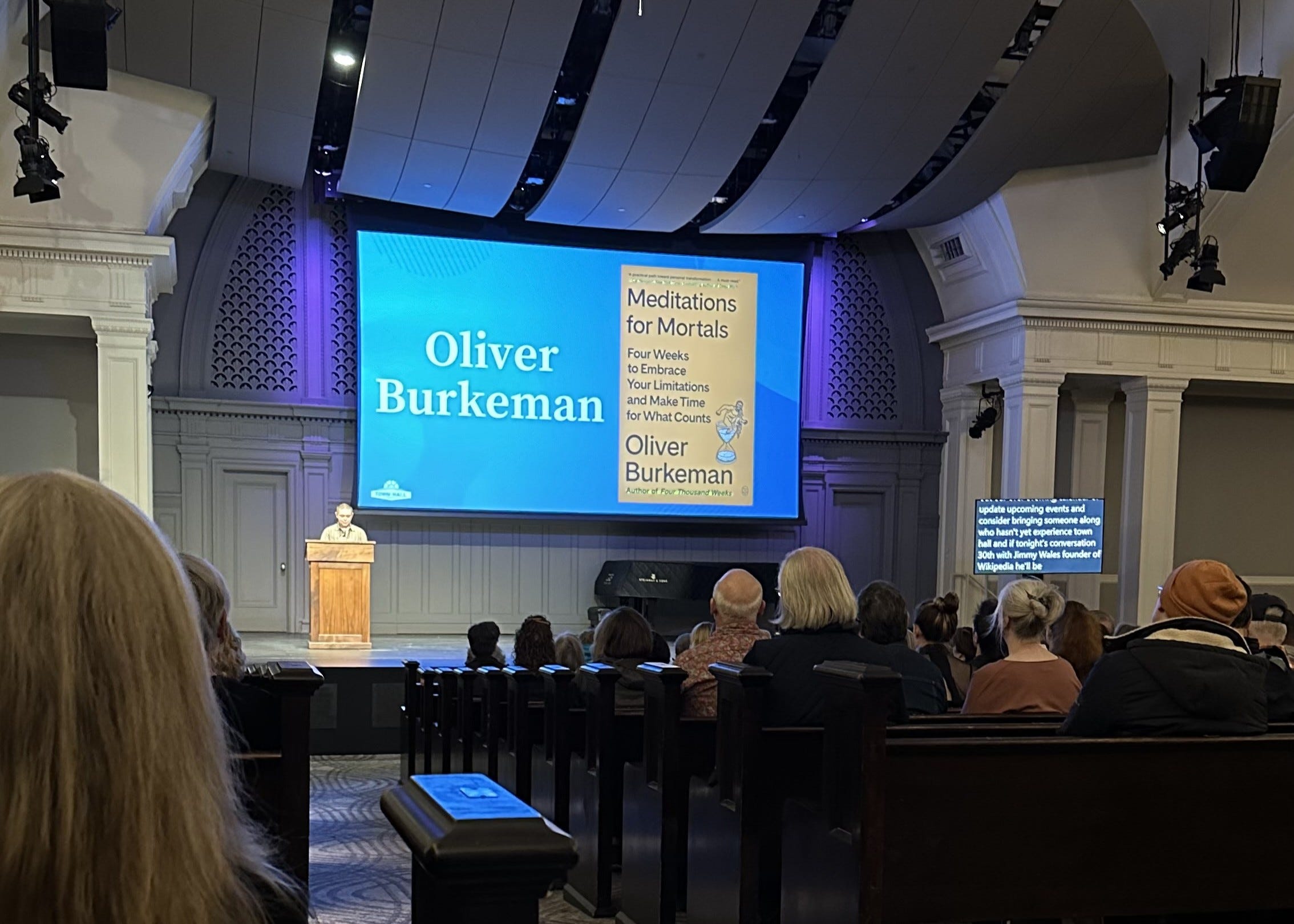
I was tired the evening of this talk. The sort of tired where I didn’t know if I would be able to make it past the couch to the front door of my apartment. But I had been looking forward to hearing Oliver Burkeman for months, so I went anyway. I half-expected a small, devoted audience for what I assumed was an obscure British philosophical self-help writer. Instead, the room was full. Packed, in fact. It turns out I was not the only one feeling a little overextended, a little uncertain about how to manage the pace of my life. It felt like we had all arrived with the same question tucked somewhere in our bags: how do we live without feeling like we are always falling behind?
Burkeman’s breakout book was Four Thousand Weeks: Time Management for Mortals, a surprise bestseller that turned the language of productivity on its head by arguing that our problem isn’t efficiency but denial. His new book, Meditations for Mortals, continues that project in a more reflective, almost devotional way. The ideas build on one another: imperfectionism as a daily practice, the “done list” as a way to see what actually matters, and the invitation to live reality-based lives rather than waiting for perfect circumstances. The theme that runs through all of it is humility: a reminder that time is not a problem to solve, but the medium in which we live.
Some of Burkeman’s ideas landed squarely for me, especially his notion of reality-based living. The idea that life is not a waiting room for when the conditions are perfect, but something already in motion, feels both bracing and right. Other concepts, like imperfectionism, are harder to swallow. I don’t particularly want to embrace my limits. I want to stretch them, test them, live as fully as possible inside them. But I do see the wisdom in learning to work with what I have instead of against it. Maybe the goal isn’t to surrender to limitation, but to collaborate with it. To shape a life that’s both aware of its boundaries and determined to make something beautiful within them.
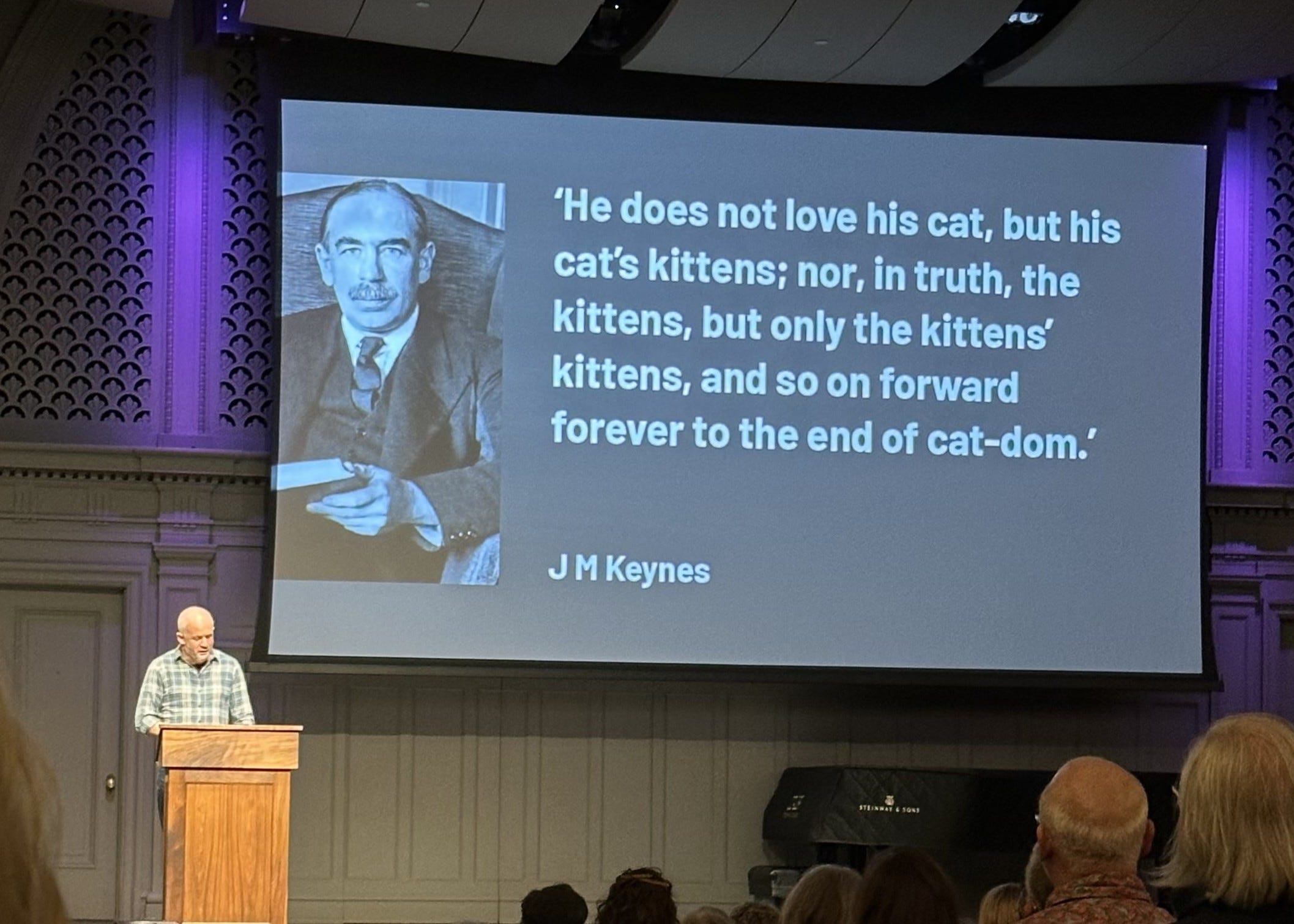
I have a one-year-old, which means I am almost always tired and almost always certain that I am not doing enough. So in some ways, the talk was a little depressing. I am never going to have time to do all of the things I want to do. The reality of limitations does not feel liberating to me. It feels like loss. I understand the argument that accepting our finitude allows us to relax, since no one ever gets to everything anyway. But I am not quite there. What did feel reassuring, though, was the reminder that where I place my energy matters. If most of it is going into my kid right now, that is not a failure of ambition. That is the work. Humans have short lives, but our children carry our histories, our values, and the shape of our attention into the future. There is something quietly enduring about that. I am not sure Burkeman convinced me to embrace the limits of my hours, but after the talk he did offer me one piece of advice that landed perfectly. Kid got you beat? Get some sleep.